Zaplens vs Optimizely vs VWO
An honest look at what's actually different — in method, pricing, and speed — between three tools people keep lumping together.
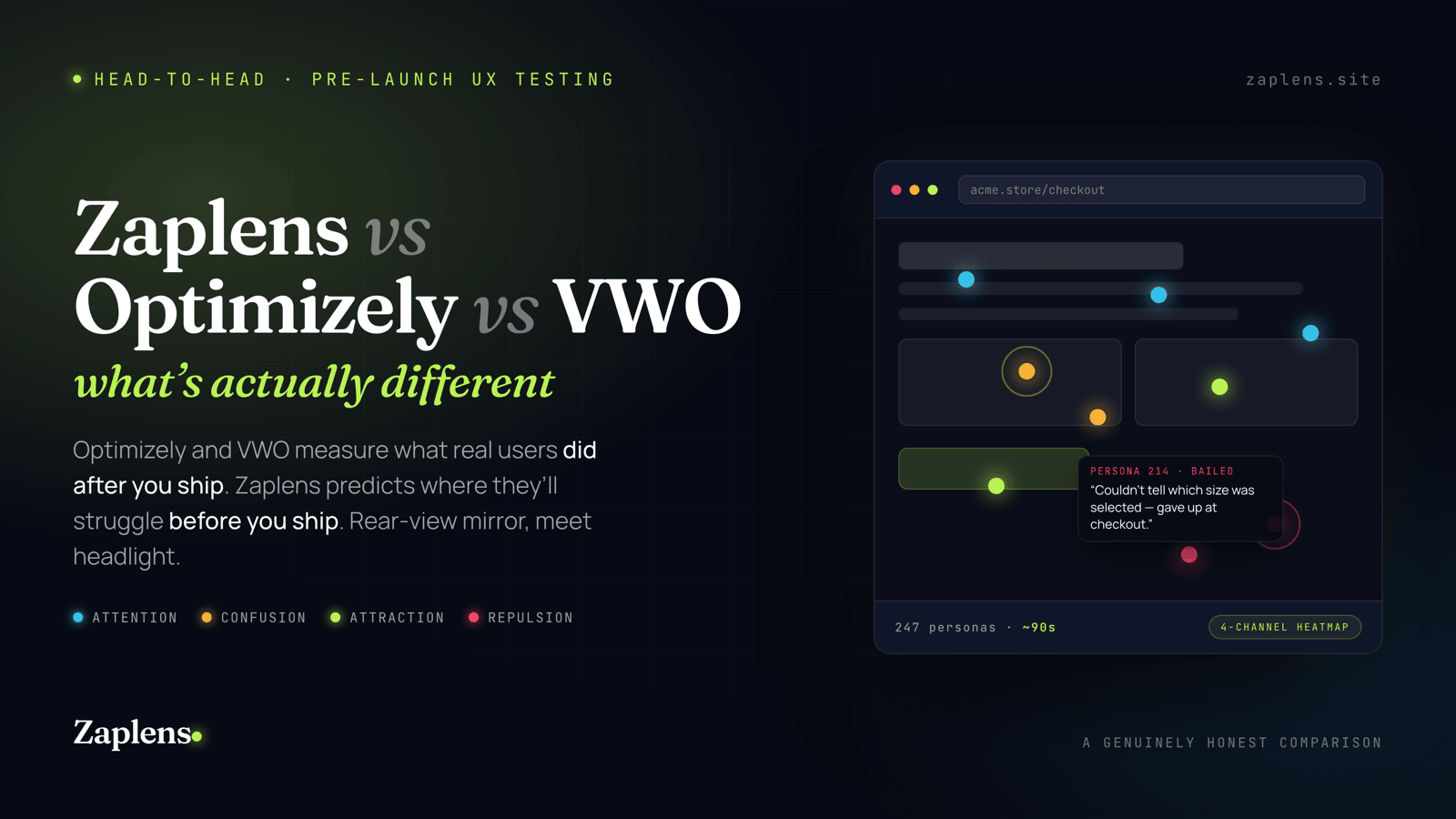
Let me say the honest thing first, because the alternative is the kind of comparison post that gets you dunked on by the exact people I'm writing for. Zaplens is not a better Optimizely. It isn't a cheaper VWO either. It's a different thing that solves a problem those two were never built to touch, and the moment you understand the difference, the question stops being "which one wins" and becomes "which one do I reach for, and when."
So this isn't a feature grid with our column conveniently glowing green. Optimizely and VWO are good at what they do. I'll tell you what that is, where the cost and the waiting actually bite, what we do instead, and where you'd be foolish to use us over them. If you came for a hatchet job, you'll be disappointed.
What Optimizely and VWO actually are
Both are real A/B testing platforms, and both have earned their reputations.
Optimizely started in 2010, built by Dan Siroker and Pete Koomen, and for years it was the name in experimentation. In 2020 it got acquired by Episerver, which then took the Optimizely name for the whole combined company. So the thing called "Optimizely" today is a full digital experience platform: content management, commerce, personalization, and experimentation bundled into one enterprise suite. Experimentation is one room in a much bigger building now, and the building is sold to big companies by a sales team.
VWO is the other heavyweight, and it comes from a more bootstrapped, scrappier lineage. It's the product of Wingify, founded in New Delhi in 2009 by Paras Chopra, originally under the name Visual Website Optimizer. They pioneered the visual editor that let marketers change a page without bugging a developer, and today VWO is a connected stack: testing, behavior analytics, heatmaps, surveys, personalization. They say they serve over 3,000 brands across 90-plus countries, and a private equity firm, Everstone, recently took a majority stake.
Here's what matters for this comparison. Both tools work the same fundamental way, the way every classic A/B testing tool works: you split your live traffic, show variant A to some people and variant B to others, and wait for enough real visitors to flow through that the result clears statistical significance. That model is sound. It's the gold standard, honestly. It also quietly assumes something most companies don't have.
The thing both of them assume you have
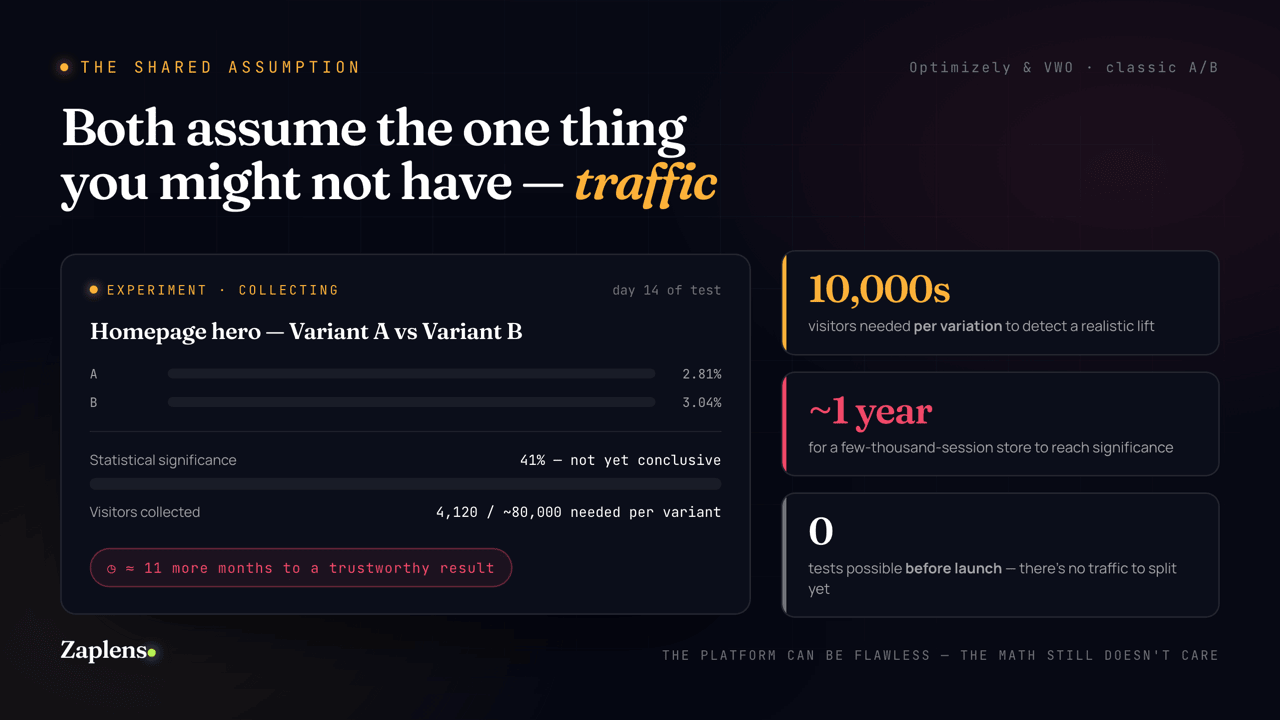
Traffic. A lot of it.
I wrote a whole separate piece on the math, so I'll keep it short here: to detect a realistic conversion lift on a typical ecommerce conversion rate, at normal confidence and power, you need on the order of tens of thousands of visitors per variation. For a store doing a few thousand sessions a month, a single test can take a year or more to conclude, by which point you've changed your theme, rotated your ad creative, and run through two seasons. The answer arrives describing a store that no longer exists.
This is not a knock on Optimizely or VWO. It's arithmetic, and it's the same arithmetic for any tool built on splitting real traffic. The platform can be flawless and the math still doesn't care. If you don't have the volume, a classic A/B test isn't slow, it's impossible, and no amount of slick UI changes that.
And there's a second assumption hiding underneath the first: the traffic has to already exist. You cannot split-test a page that hasn't launched. So an agency shipping a brand-new site, or a founder about to point paid spend at a fresh landing page, is testing in the dark at exactly the moment a mistake is most expensive. The real user data shows up weeks later, after the money's already been spent.
What Zaplens does instead
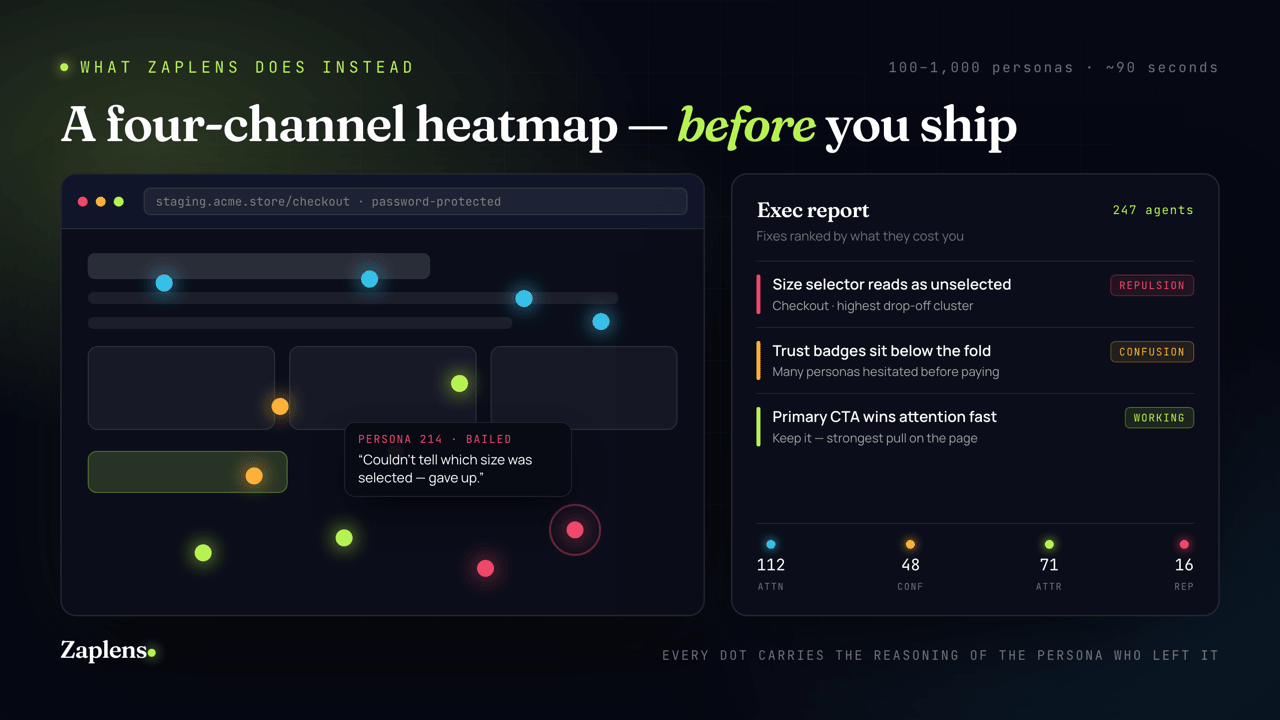
We deleted the traffic requirement. That's the whole idea in one sentence.
Instead of waiting for real visitors to split, you send a crowd of 100 to 1,000 AI personas through your site with a real goal, find this product and check out, sign up for the trial, book the demo, and watch where they hesitate, get confused, and bail. You get back a four-channel heatmap, Attention, Confusion, Attraction, and Repulsion, where every single dot carries the reasoning of the persona who left it. Plus an exec report and a list of fixes ordered by how much they're costing you. The whole thing takes about 90 seconds, and it works on a page with zero traffic, including staging builds behind a password.
That's the innovation, and it's worth being precise about what kind of innovation it is. It is not "AI-flavored A/B testing." It's a different measurement entirely. Optimizely and VWO measure what real people did after you shipped. Zaplens predicts where people will struggle before you ship, by simulating the reasoning of many different kinds of shopper against your actual pages. One is a rear-view mirror, accurate and trustworthy and pointed at the past. The other is a headlight.
There's a feature we call Battle Mode that makes the contrast concrete. Point it at your old product page and your new one, or two checkout layouts, and it runs both head-to-head, crowns a winner with a per-persona breakdown of who preferred what, and shows you a diff of exactly what changed. It's the comparison an A/B test gives you, except you get it by lunch instead of after 40,000 sessions, and you never risk real revenue on the losing variant because no real customer ever saw it.
Where I'd tell you NOT to use us
This is the part the skeptics are waiting for, so here it is straight.
Synthetic shoppers are a leading indicator, not a replacement for validating with real customers. They're exceptional at catching the loud, expensive, obvious confusion: the dead button, the variant picker nobody understands, the checkout step where everyone quits. The stuff you'd frankly be embarrassed to have spent six weeks A/B testing because the answer was sitting there the whole time. They are not the tool for settling a genuinely close call, a 3% difference that hinges on the real quirks of your real audience. For that, you want exactly what Optimizely and VWO do: real traffic, real significance, real patience.
So if you're a large company with plenty of traffic and a mature experimentation team, those platforms are built for you, and you should use them. If you need content management and personalization and commerce all under one roof, that's the Optimizely DXP pitch, and we don't play in that yard at all. If you've got the volume to run proper tests and the discipline to run them well, run them.
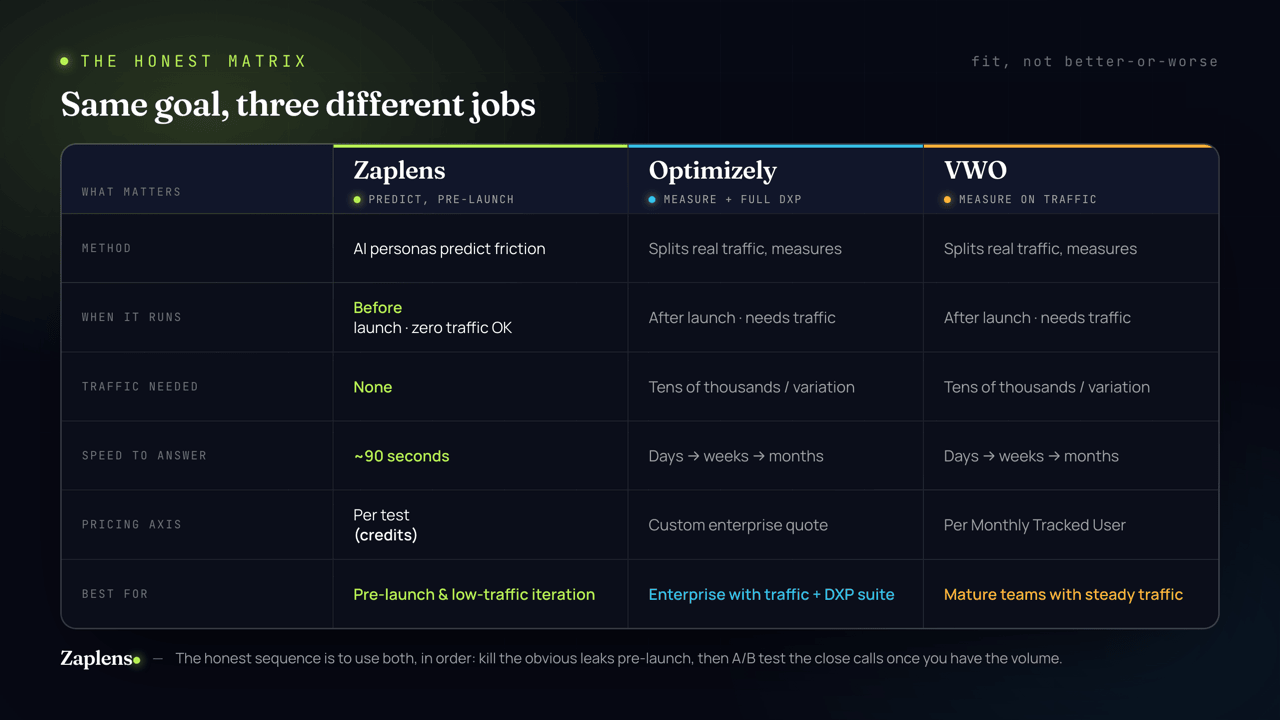
The honest sequence is to use both, in order. Zaplens to find and kill the obvious leaks today, before you spend another dollar driving traffic into them. Then a real A/B test on the close calls, once you've got the volume to do it properly. We're the pre-flight check, not the destination.
Pricing: three genuinely different structures
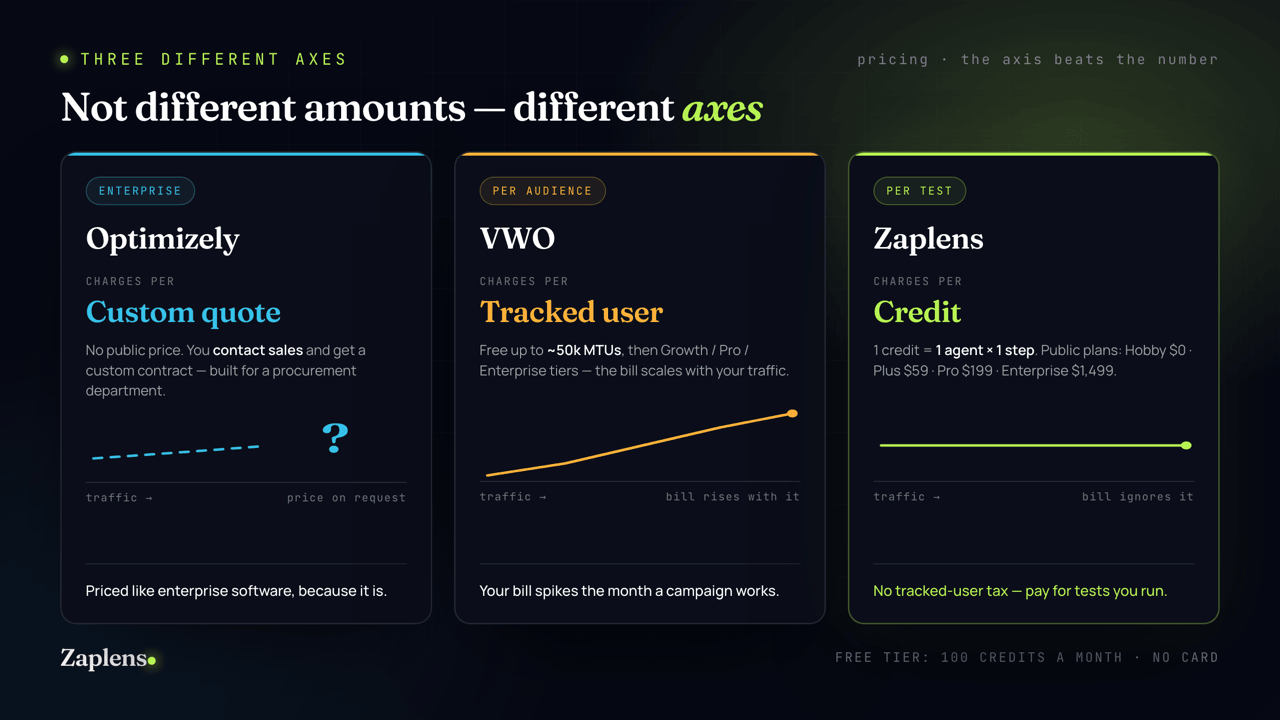
This is where the comparison gets concrete, because the three tools don't just charge different amounts. They charge on different axes, and the axis matters more than the number.
Optimizely doesn't publish a price for its experimentation product at all. It's an enterprise sales motion: you contact them, you talk to a rep, you get a custom quote. I'm not going to invent a number, because they don't print one, and anything I made up would be guesswork wearing a suit. What I can tell you is the shape of the thing. It's sold as part of a platform, to companies that buy software through a purchasing process, with a contract and a signature at the end. There's nothing wrong with that model. It's just built for a buyer with a procurement department, not a founder with a credit card open at 11pm.
VWO publishes its pricing, and it's more accessible, but it's metered on Monthly Tracked Users, your MTUs. The more visitors you track, the more you pay, and the bill scales with your traffic. They offer a free tier (up to 50,000 monthly tracked visitors on their testing product, last I checked) and paid tiers, Growth, Pro, and Enterprise, with the bigger tiers moving back behind a "schedule a demo" button. The MTU model is common and fair on its face, but it has a sharp edge worth naming: your tool bill goes up in the exact month your traffic spikes, which is to say the month a campaign is working and cash is tightest. You get punished, a little, for succeeding.
Zaplens charges for work done, not for traffic watched. A credit is one agent doing one step of a traversal, and that's the whole meter. The plans are public, and you can read every number without talking to a soul: a free Hobby tier with 100 credits a month and no card, Plus at $59 a month for 1,500 credits, Pro at $199 for 8,000 (that's the tier with Battle Mode, the API, and the MCP server), and Enterprise from $1,499. Pay for the year up front and the monthly rate drops about 20%, to $47 for Plus and $159 for Pro. Don't want a subscription at all? Credit packs go $35 for 500, $129 for 2,500, $399 for 10,000, and those don't expire. The part that actually matters for this comparison: there's no tracked-user tax. A big traffic month never lands you a surprise bill, because your bill has nothing to do with your traffic in the first place. You pay for tests you run, and that's it.
Stack the models up and the philosophies are clear. Optimizely prices like enterprise software because it is enterprise software. VWO prices on the size of your audience. Zaplens prices on the amount of testing you actually do. None of those is wrong. They're aimed at different people.
Why this matters for a team that moves fast
Everything above lands hardest for one kind of team: the one that ships often and can't afford to wait.
Think about the loop a fast-moving team actually lives in. You redesign a product page on Monday. With a classic A/B test, you ship it, split the traffic, and wait, days at best, weeks more likely, a year if you're small, before the data says anything trustworthy. Meanwhile you've already moved on to the next three things. The feedback arrives long after the decision is cold, which means most of the time it never really closes the loop at all. You just shipped on instinct and hoped.
Now run the same Monday through Zaplens. You redesign the page, zap it with 200 personas, read the criticals, fix them, and zap again, several times before lunch. The loop closes in 90 seconds instead of six weeks. A team that can run eight evidence-based iterations before launch will, on average, ship something that converts better than a team that ships on taste and finds out in production. That iteration speed compounds, and it's the entire reason a small, fast team should care about the difference between predicting friction and measuring it after the fact.
It also fits how fast teams already buy. No procurement cycle, no demo gate to see a price, no annual lock-in to start, no bill that punishes your best traffic month. You sign up, you zap, you see your leak. The tool moves at the speed you do.
I'll end where I started, because it's the only honest place to end. If you have the traffic and the time, Optimizely and VWO are proven, and you should use them for the close calls that deserve real-user proof. But if you're shipping fast, launching things with no traffic yet, or sitting below the volume line where classic testing quietly stops working, you don't need a faster horse. You need a different animal. That's the one we built.
Sources
Competitor facts below were checked against the companies' own materials and public records. Pricing for all three tools moves, so verify the current numbers before quoting them in a sales conversation.
- Optimizely founding (2010, Dan Siroker and Pete Koomen), acquisition by Episerver (October 2020), and the rebrand of the combined company to "Optimizely" (January 2021) — Wikipedia's Optimizely entry, corroborated by the company's own history. Optimizely today is positioned as a digital experience platform (content, commerce, personalization, experimentation).
- Optimizely pricing model (no public list price; enterprise contact-sales / custom quote) — Optimizely's own pricing page routes to a sales contact rather than publishing experimentation prices. No dollar figure is quoted here on purpose: Optimizely doesn't print one, so any number would be guesswork. Treat it as "custom enterprise quote, talk to their sales team."
- VWO / Wingify (founded 2009 in New Delhi by Paras Chopra, originally "Visual Website Optimizer"; pioneered the marketer-facing visual editor; serves 3,000+ brands across 90+ countries; majority stake acquired by Everstone Capital) — VWO's own About page (vwo.com/about-us). Verified against the live source.
- VWO pricing model (metered on Monthly Tracked Users; free tier up to ~50,000 monthly tracked visitors on VWO Testing; paid tiers Growth, Pro, Enterprise, with higher tiers behind "schedule a demo") — VWO's pricing page (vwo.com/pricing). The exact dollar figures are set by an MTU slider and change with traffic volume and product mix, so I've described the structure rather than quote a single price; check the live page for your MTU band.
- The "you need tens of thousands of visitors per variation / a small store waits a year" math — covered in detail, with sources, in a companion post on running a trustworthy A/B test. Standard two-proportion sample-size calculation at 95% confidence / 80% power.
- Zaplens facts (method, four-channel heatmap with per-dot reasoning, Battle Mode, staging/authenticated-page support, ~90-second runs) and pricing — pricing read live from the Zaplens landing page (zaplens.site): Hobby $0 / 100 credits per month; Plus $59/mo ($47/mo billed annually, $566/yr) / 1,500 credits; Pro $199/mo ($159/mo billed annually, $1,910/yr) / 8,000 credits, with Battle Mode + API + MCP; Enterprise from $1,499/mo (annual contract) / 40,000+ credits. Pay-as-you-go credit packs: 500/$35, 2,500/$129, 10,000/$399; credits don't expire; no tracked-user fee. 1 credit = 1 agent × 1 traversal step. Re-check the live pricing page before quoting, since plans change.
A note on fairness: Optimizely and VWO are mature, well-regarded tools, and nothing here is meant to suggest otherwise. The comparison is about fit, not quality. They measure real behavior after launch and need traffic to do it; Zaplens predicts friction before launch and doesn't. A serious team can and often should use both. Competitor pricing in particular shifts often and varies by deal, so anything stated here is directional and worth re-checking before you put it in front of a customer.
See your store's leak in ~90 seconds
Send a crowd of AI shoppers through your store with a goal, and watch exactly where they hesitate and bail — with the reasoning attached to every drop-off. 100 free credits, no card.
Synthetic shoppers are a leading indicator — a fast way to catch the obvious leaks, not a replacement for real-user validation at scale.